
Vegan Convenience Is Not Shallow, It Is Strategy
If we want compassion to become normal, vegan food must become easy, visible, affordable, and everywhere

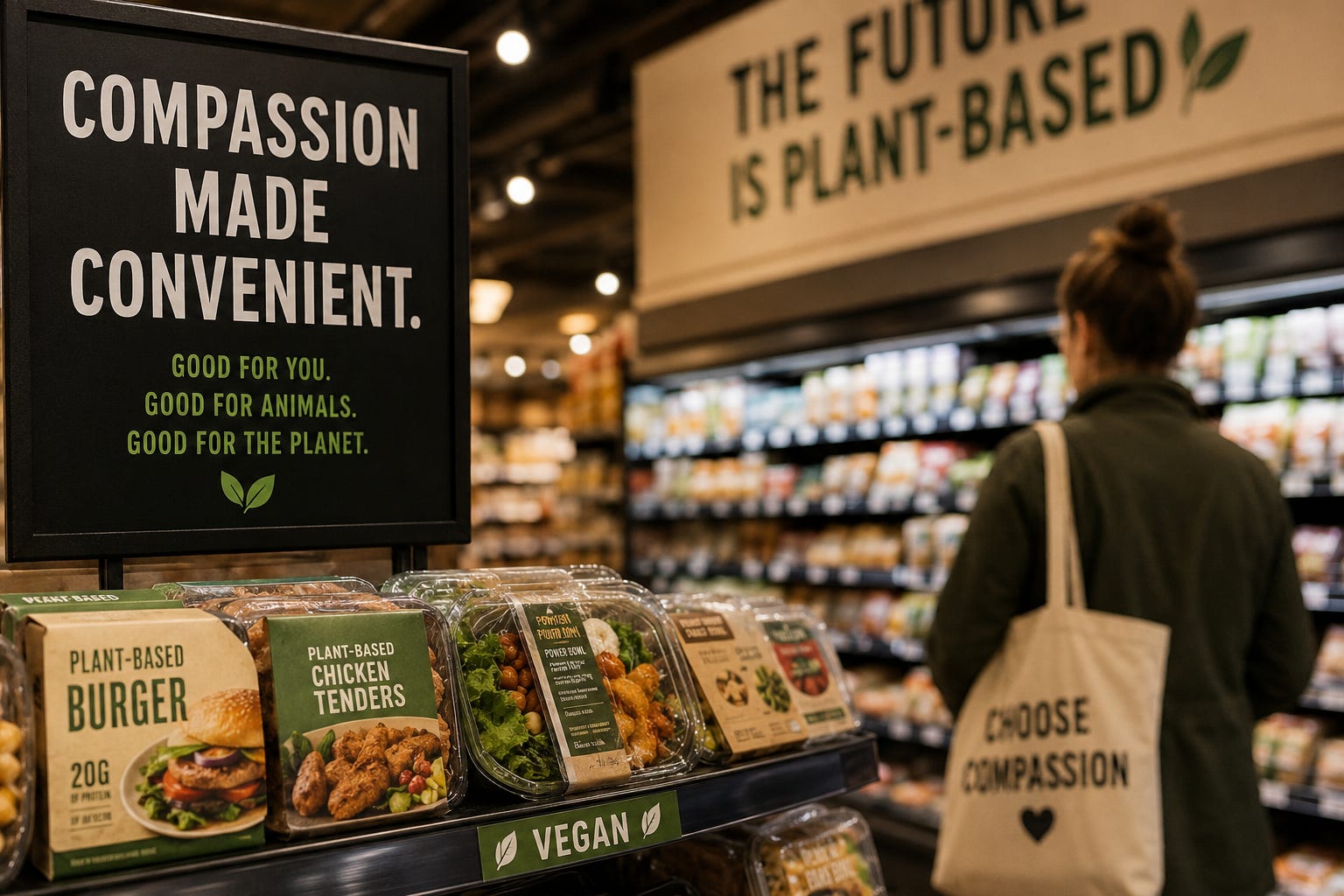
‘‘The animals do not need our purity performances.
They need fewer people buying their bodies.’’
Veganism begins as an ethical awakening, but it grows through practical access.
At its core, veganism is a refusal to treat animals as products, tools, ingredients, clothing, entertainment, or disposable bodies. It asks us to widen the circle of moral concern beyond the human family and to live as though the suffering of other beings matters.
But if we are serious about changing the world for animals, we have to admit something very practical.
Convenience matters.
Not because ethics are shallow. Not because compassion should be reduced to marketing. Not because veganism is merely a consumer trend. Convenience matters because most people live inside systems that make exploitation easy and compassion inconvenient.
That is the problem.
Exploitation Is Built Into Daily Life
Animal-based food is everywhere. It is subsidized, normalized, advertised, packaged, promoted, and placed directly in front of people from childhood onward. It is in school cafeterias, hospital meals, gas stations, airports, stadiums, fast food chains, office lunches, family gatherings, and grocery store endcaps. It is not merely chosen. It is built into the architecture of daily life.
Meanwhile, vegan food is often treated as the special request, the side option, the allergy accommodation, the afterthought, or the thing you have to plan for before leaving the house.
That has to change.
The moral argument for veganism is strong. The environmental argument is strong. The health argument, when properly framed around whole plant foods, is strong. But arguments alone don’t transform society. Infrastructure does. Access does. Visibility does. Repetition does. Normalcy does.
If we want more people to choose vegan food, vegan food has to become easier to choose.
Convenience Is Not a Compromise
The Good Food Institute reports that 53 percent of Americans have tried plant-based meat, while 40 percent ate it in the past year. That means this is not a fringe category with no public curiosity. Millions of people have already crossed the threshold at least once. The question is not whether people are willing to try plant-based food. Many are. The question is whether the food is good enough, affordable enough, familiar enough, and available enough to become a habit.
That is where convenience becomes strategy.
A person may care about animals and still be exhausted after work. A parent may be open to plant-based meals and still need something the kids will eat in twenty minutes. A college student may be morally curious and still be limited by dining hall options. A traveler may want to avoid animal products and still find themselves in an airport terminal where the only vegan meal is black coffee and a banana that looks like it survived a small war.
This is not a failure of compassion. It is a failure of access.
We should stop treating convenience as the enemy of ethical seriousness. Convenience is how habits are built. Convenience is how markets shift. Convenience is how new norms become ordinary. The easier the compassionate choice becomes, the more often it will be made.
The Animals Need Fewer Purchases of Their Bodies
This does not mean veganism should be reduced to burgers, nuggets, frozen pizzas, and oat milk lattes. Whole foods matter. Beans, lentils, vegetables, fruits, grains, nuts, seeds, and traditional plant-centered meals should remain central to any serious conversation about vegan eating.
But we should not sneer at convenience foods either.
A frozen vegan burrito may not be the peak of culinary enlightenment, but if it keeps someone from buying a beef burrito, it matters.
The animals do not need our purity performances. They need fewer people buying their bodies.
A vegan sandwich at a gas station matters. A good plant-based school lunch matters. A dairy-free coffee option that does not cost extra matters. A decent vegan burger on a fast food menu matters. A grocery store that places vegan products where ordinary people can find them matters. A restaurant menu that lists vegan meals as real meals instead of sad substitutions matters.
Visibility Is Part of Access
When vegan food is hidden in the back corner, labeled like medicine, priced like a luxury item, or treated as a suspicious lifestyle product, people receive the message that it is abnormal. When vegan food appears in the main flow of public life, people receive a different message: this is food, this is normal, this is available, this is for you.
The Plant Based Foods Association says its marketplace work focuses on increasing the availability and visibility of plant-based foods, including partnerships with retailers. That focus is exactly right. Availability alone is not enough. A product can technically exist and still be practically invisible. People have to see vegan options where they shop, eat, travel, and live.
Possible and Practicable Means Something
Of course, convenience is not the whole movement. Veganism cannot be reduced to consumer access. It is not merely about buying different products inside the same exploitative economic system. Veganism is a philosophy and way of living that seeks, as far as possible and practicable, to exclude exploitation and cruelty to animals.
But that phrase, “possible and practicable,” matters.
A society that makes vegan choices more available expands what is possible and practicable for millions of people. Better systems create better choices. Better choices create better habits. Better habits create cultural change.
This is why the future of vegan advocacy must include restaurants, retailers, schools, hospitals, food service companies, city planners, public institutions, chefs, recipe creators, product developers, and community organizers. The movement cannot live only in argument threads and moral debates. It has to live in lunch lines, grocery aisles, neighborhood cafes, public events, and family kitchens.
We need a vegan world that is not only morally compelling, but logistically livable.
The Four Practical Requirements
That means affordability. Vegan food cannot be treated as a boutique product for people with extra money and extra time. Beans and rice are affordable, yes, but access is more complicated than pointing to dry lentils and calling the problem solved. People also need prepared meals, familiar flavors, quick options, workplace lunches, children’s meals, and reliable choices when life gets chaotic.
That means taste. People return to food that satisfies them. If a vegan option is bland, dry, tiny, overpriced, or obviously added to the menu out of obligation, it does not help the cause. It confirms every lazy stereotype.
That means placement. Vegan food should not require a scavenger hunt. It should be easy to find, easy to order, and easy to understand.
That means dignity. Vegan meals should not be framed as deprivation. They should be presented as real food, full food, desirable food, food with flavor, culture, comfort, and joy.
The goal is not to make veganism less ethical. The goal is to make ethics easier to practice.
Social Change Often Begins With Habit
There will always be people who change because they watched slaughterhouse footage, read a book, heard a speech, or had a moment of moral awakening. Those people matter. But many others will change gradually because the plant-based option was there, tasted good, cost the same, and fit into their lives.
That may sound less dramatic, but it is powerful.
Social change often happens when the better choice becomes easier, not only when the old choice becomes indefensible. Seatbelts became normal. Recycling became normal. Smoking indoors became abnormal. Marriage equality moved from controversial to ordinary in much of public life. Culture shifts when morality, law, infrastructure, and daily habit begin reinforcing each other.
Veganism needs that kind of shift.
We need the compassionate choice to stop feeling like a personal obstacle course.
Ethics Must Become Culture
Every time vegan food becomes easier to choose, an animal is less likely to be used. Every time a school adds a strong plant-based lunch, a child learns that compassion belongs in ordinary life. Every time a restaurant makes its vegan option delicious instead of grudging, it lowers the cultural resistance. Every time a grocery store gives plant-based foods visibility, it helps normalize a future beyond animal exploitation.
The vegan movement does not need to choose between moral clarity and practical access. It needs both. We need the truth about animals, and we need food systems that help people live according to that truth.
Because the door to veganism may open through food, but what stands behind that door is much larger.
It is a different relationship with animals.
It is a different understanding of power.
It is a different measure of progress.
A compassionate society cannot be built only by telling people to care more. It must also remove the barriers that make caring difficult.
So yes, we need better arguments. We need moral courage. We need education. We need the truth spoken plainly.
But we also need vegan sandwiches in gas stations, plant-based meals in schools, dairy-free options without punishment pricing, airport food that is not a sad banana, and grocery aisles that make compassion visible.
That is not shallow.
That is how ethics becomes culture.
Also read: Vegan Food Opens the Door, The Vegan’s Voice Walks Through the Whole House
Before you head out, hit the ❤️ and re-stack this post to amplify The Vegan’s Voice and bring this conversation to more people who need to hear it. I also have a vegan education and outreach page on Facebook: The Vegan Project. Please stop by for much more information on veganism and plant-based living.
I know some may not want to commit to a paid subscription, but if you’d like to support my work, you can always buy me a coffee on Ko-fi. Your contribution helps sustain independent writing rooted in consciousness, compassion, and social renewal. Every bit of support truly makes a difference.
Thank you! In the whole-food-plant-based community we call those convenience foods “entry level” vegan foods. They prove that you can happily survive while saving animals’ lives and protecting the planet. Next step would be controlling the salt content, or better yet learning all the ways to prepare your own healthy meals at home. The movement is growing!
Thanks, Michael for this excellent analysis. I am happy to report that at my local chain grocery store, the refrigerated “prepared vegan” section (tofu, tempeh, plant-based cheeses, cold cuts, burgers and sausages, edamame, potstickers, kimchi, miso, vegan mayo and salad dressings, etc.) is always picked over, as are the organic produce aisle and the frozen vegan section. The store also sells a lot of plant-based butter, milk, creamers, yogurt and frozen desserts. I often come away empty-handed and have learned to stock up in advance on staples, like organic tofu and tempeh. I live in the rural high desert of Southern California and we get lots of visitors from Los Angeles and San Diego, mainly young people who eat more plant foods. Makes me happy and our grocery stores are paying attention! 🌱