
Speaking for Those Who Cannot Speak
My Favorite Vegan Memes

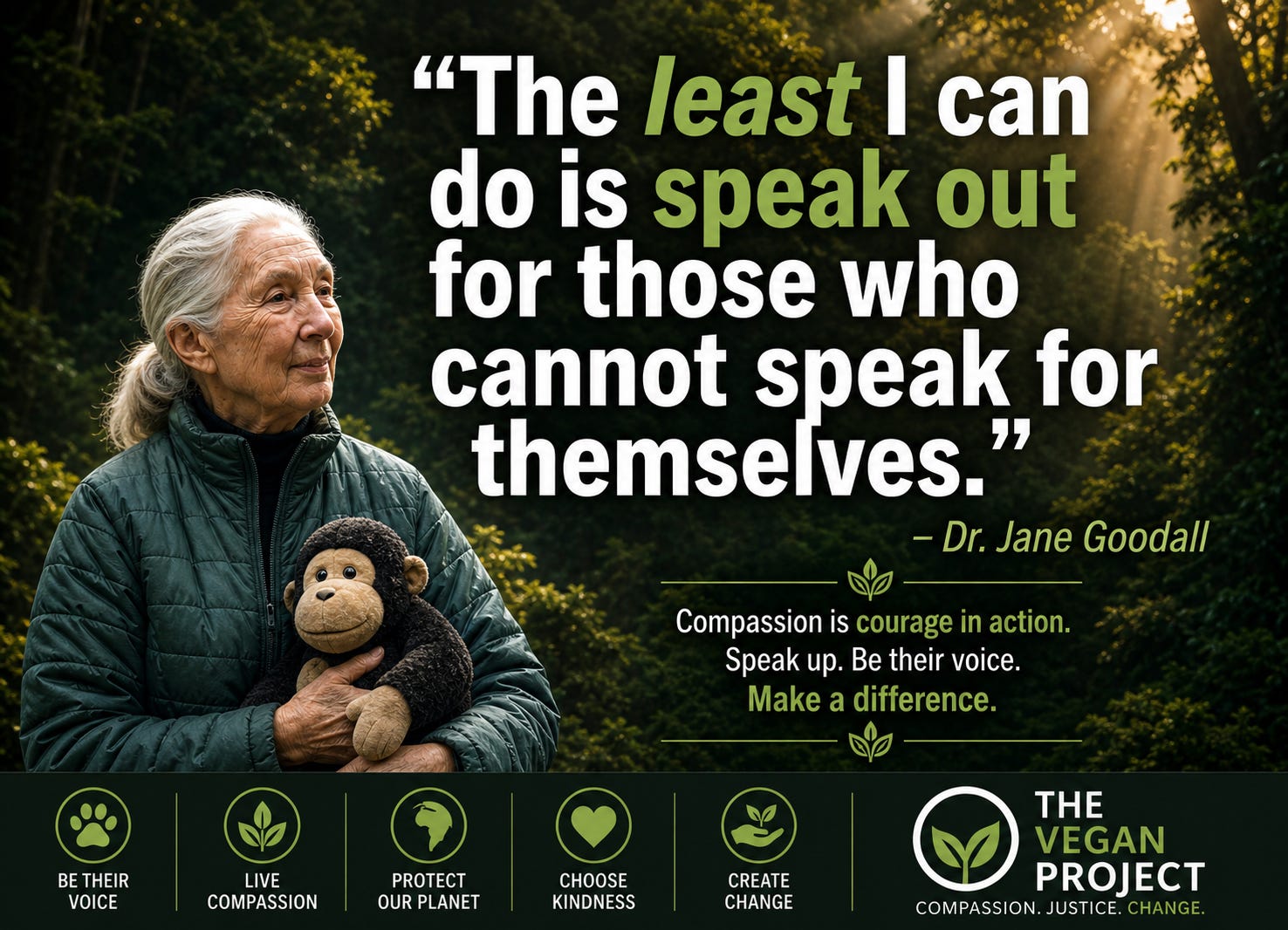
Jane Goodall’s words carry power because they come from a life spent listening to beings the modern world too often treats as silent. Her moral clarity is not sentimental. It is disciplined, patient, and rooted in observation. She did not become a voice for animals by standing above nature, but by entering it with humility and attention.
The message in this meme, “The least I can do is speak out for those who cannot speak for themselves,” belongs to that deeper ethic. It reminds us that compassion is not passive emotion. It is responsibility. When another being suffers under systems they did not create and cannot challenge, silence becomes cooperation. To speak is not merely to express sadness. It is to interrupt harm.
Goodall’s work helped change the way many people see nonhuman animals. She showed that animals have personalities, relationships, intelligence, emotional lives, and communities. That matters because exploitation depends on distance. It asks us not to look too closely, not to ask too many questions, and not to notice the individuality of the beings being used.
This message is especially important in vegan advocacy. Farmed animals, lab animals, wild animals, and captive animals cannot lobby, vote, write essays, organize campaigns, or testify in court. Their suffering enters the human world only when someone chooses to name it. That is why speaking out is not arrogance. It is solidarity.
But speaking should not be the end. Words should become choices. Choices should become habits. Habits should become justice. When we speak for animals, we are not pretending to own their voice. We are refusing to let their silence be used against them.
Jane Goodall’s words call us back to moral courage. Compassion asks more than admiration for animals. It asks us to defend them, protect them, and stop supporting the systems that harm them. That is how a voice becomes change.
Before you head out, hit the ❤️ and re-stack this post to amplify The Vegan’s Voice and bring this conversation to more people who need to hear it. I also have a vegan education and outreach page on Facebook: The Vegan Project. Please stop by for much more information on veganism and plant-based living.
I know some may not want to commit to a paid subscription, but if you’d like to support my work, you can always buy me a coffee on Ko-fi. Your contribution helps sustain independent writing rooted in consciousness, compassion, and social renewal. Every bit of support truly makes a difference.
This is what the Psychologist Mihaly Csikszentmihalyi has to say about good and evil in his book Finding Flow: The Psychology of engagement with everyday life. 'Contemporary understanding of matter and energy...suggests a new way of thinking about good and evil. Evil in human affairs is analogous to the process of entropy in the material universe. We call evil that which causes pain, suffering, disorder in the psyche or the community. It usually involves taking the course of least resistance, or operating according to the principles of a lower order of organization...Entropy or evil is the default state, the condition to which systems return unless work is done to prevent it. What prevents it is what we call "good" - actions that preserve order while preventing rigidity, that are informed by the needs of the most evolved systems. Acts that take into account the future, the common good, the emotional well-being of others. Good is the creative overcoming of inertia, the energy that leads to the evolution of human consciousness. To act in terms of new principles of organization is always more difficult, and requires more effort and energy'. The actions of vegans in speaking for those who cannot speak, and non vegans in violating and oppressing them need to be seen in the context of good and evil. Only then will people be empowered to bring about positive change.