
Juneteenth and the Wider Meaning of Freedom
Honoring Black liberation while widening the circle of compassion

“Juneteenth reminds us that freedom delayed is freedom denied, and that justice becomes deeper when compassion keeps expanding.”
A Day of Memory and Celebration
Juneteenth is not simply a date on the calendar. It is a day of memory, celebration, grief, truth, and unfinished moral work. It marks June 19, 1865, when Union troops arrived in Galveston, Texas, and announced that enslaved Black people were free. This came more than two years after the Emancipation Proclamation.
That delay matters. It reminds us that justice can be declared long before it is delivered. It also reminds us that power often resists freedom, even after freedom has become law.
To honor Juneteenth honestly, we must begin with its history. Enslaved people in Texas had been held in bondage after emancipation had already been proclaimed. Their freedom was not a gift handed down by the powerful. It was the result of struggle, resistance, war, courage, and the determination of Black people who never surrendered their humanity, even when the law and economy denied it.
Juneteenth celebrates liberation, but it also exposes the cruelty of systems that turn living beings into property.
The Moral Weight of Liberation
Any connection between Juneteenth and veganism must be made carefully. The point is not to equate the enslavement of Black people with the exploitation of animals. Human slavery, white supremacy, and the long struggle for Black liberation carry their own historical weight. They must never be flattened into a convenient metaphor.
Juneteenth belongs first to Black history, Black freedom, Black remembrance, and Black joy. Any broader ethical reflection must begin there, with humility and respect.
But Juneteenth also invites a deeper moral examination. It asks us to confront the logic of domination. It asks us to look honestly at what happens when a society normalizes ownership, control, violence, and profit over the lives of others.
Veganism, at its moral core, asks a related question: where do we still accept suffering because it is convenient, traditional, profitable, or hidden from view?
Not Comparison, but Moral Reflection
This is not a comparison of suffering. It is a recognition of a pattern. Systems of exploitation often depend on distance. They hide the pain. They rename the victim. They turn a being into a thing. They teach people not to look too closely.
Juneteenth breaks that spell by remembering a truth slavery tried to deny: those treated as property were always fully human. Veganism challenges another form of moral blindness by insisting that animals are not objects, machines, or ingredients, but sentient beings with their own desire to live.
That connection should be made with care, not shock. It should never use Black suffering as a rhetorical shortcut. Instead, it should honor Juneteenth as one of America’s essential freedom days while allowing its moral force to deepen our understanding of justice.
Freedom, once taken seriously, asks something of us.
Food, Culture, and Compassion
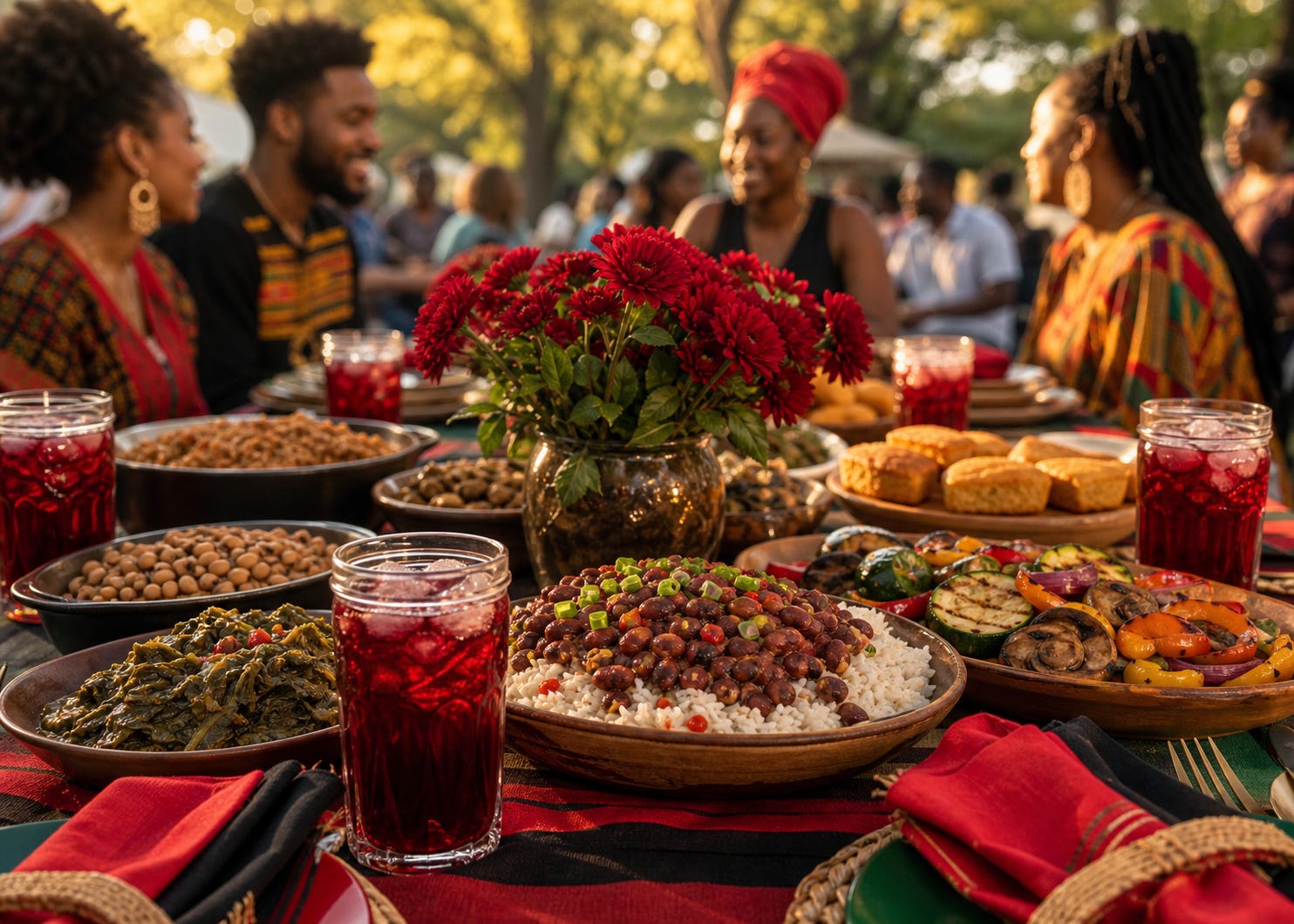
Food is one of the most meaningful places where these conversations meet. Juneteenth celebrations have long included food as a form of culture, survival, joy, and community. Red foods and drinks, such as hibiscus tea, watermelon, red beans, and red velvet cake, carry symbolism connected to sacrifice, bloodshed, resilience, and renewal.
Barbecue, greens, cornbread, beans, and soul food traditions reflect memory, creativity, family, and celebration. These foods tell a story. They are part of the cultural richness of Juneteenth.
A vegan Juneteenth table can honor that history without erasing it. It can include red beans and rice, collard greens cooked with smoke and spice instead of pork, barbecue jackfruit, smoked mushrooms, grilled vegetables, black-eyed peas, dairy-free cornbread, hibiscus punch, watermelon salad, and dairy-free red velvet cake.
These foods can be joyful, rooted, and respectful. They do not reject tradition. They continue it through a lens of compassion, health, and care.
Food Justice Matters
A respectful vegan message must also speak honestly about food justice. Veganism should not be presented as a lifestyle of privilege or purity. At its best, it belongs with community health, environmental responsibility, access to fresh food, and economic justice.
Many Black communities have faced food deserts, aggressive fast-food marketing, environmental racism, health disparities, and limited access to affordable produce. So the question is not only what people eat. It is also what choices are actually available, who controls the food system, and who benefits from the suffering built into it.
A veganism that ignores these realities is incomplete. A veganism shaped by justice asks how compassion can become practical, accessible, and community-centered.
A Freedom That Keeps Growing
Juneteenth teaches that liberation is not complete when a law changes. Liberation must become real in bodies, homes, neighborhoods, schools, economies, and daily life.
Veganism, when grounded in humility and justice, can be part of a wider moral imagination. It asks us to widen compassion without stealing focus from human struggles. It asks us to build a world where suffering is not hidden, freedom is not selective, and no life is reduced to its usefulness.
To celebrate Juneteenth as a vegan is to honor Black liberation first. It is to remember the cruelty of bondage, the courage of the freed, and the ongoing fight against racism. Then, from that place of reverence, it is to ask a larger question: if freedom is sacred, how can we practice it more fully?
Juneteenth does not need veganism to be meaningful. It already stands as one of America’s most important freedom days. But veganism can learn from Juneteenth. It can learn that justice delayed is justice denied. It can learn that tradition should be honored, not exploited. It can learn that liberation is strongest when rooted in truth, community, and compassion.
Freedom, once taken seriously, asks something of us.
Discover the truth about veganism beyond just a diet. This practical guide explains ethical principles, daily choices, and compassionate living, giving beginners the tools and understanding to embrace a lifestyle that respects animals, the planet, and personal integrity.
Download Veganism: A Practical Introduction
Before you head out, hit the ❤️ and re-stack this post to amplify The Vegan’s Voice and bring this conversation to more people who need to hear it. And please check out my vegan outreach page on Facebook.
I know some may not want to commit to a paid subscription, but if you’d like to support my work, you can always buy me a coffee on Ko-fi. Your contribution helps sustain independent writing rooted in consciousness, compassion, and social renewal. Every bit of support truly makes a difference.
Thank you, Michael. A brilliant article. 💙🌱